Posted on 7 Comments

3 of the best essential oils for upset stomachs

Three best essential oils for upset stomachs

Essential oils are one of many all-natural remedies to help with a tummy ache. They are pure, powerful and effective. If someone in my family complains of tummy trouble, I use a blend of three essential oils for upset stomachs.

As with any treatment, consult a doctor before using essential oils if you are allergic, pregnant or nursing. Only your doctor can tell if you if essential oils might interact with any other medications you are taking.

Natural remedies for upset stomachs

When you think about it, most people already use all-natural remedies to combat an upset stomach.

As a kid, the school nurse used to give me peppermint candies when I complained of a tummy ache. Lots of people try ginger ale or ginger soda for indigestion.  You may even brew ginger or mint tea to combat an upset stomach. Turning to over-the-counter medicine, those little chalky little tablets (if you’ve been pregnant, you definitely know what I’m talking about) are actually calcium carbonate, which occurs naturally.

Collecting essential oils

Hubs was no believer. He found my collection of essential oils to be pretty annoying. Yeah, I understand. If you have enough of them, those tiny brown bottles take up entire shelves in your bathroom and appear in bags, drawers and cabinets all over the house and car. If you live with someone, that person might get a little frustrated with your essential oil collection. Until…the moment comes when she or he needs them.

This blend of three essential oils works so well on my husband’s upset stomach, it changed his perspective on my whole collection of little brown bottles. Whenever he isn’t feeling well, he asks me to blend these oils for him to rub on his belly, and it hasn’t failed him yet.

Where do I buy essential oils?

Your friends and family may have strong preferences for a certain brand of essential oils over another. I don’t. Just do a quick search online to learn more about the reputation of the essential oil company before you buy. If it’s an established, trusted essential oil company, then you will probably get your money’s worth. 

Essential oils are expensive. You can easily spend $15 to $50 on a single bottle. If you can afford them, they do last a long time. I’ve had many for several years, which is why I built up such a large collection that they are all over the house.

You can find a huge variety of essential oils online direct from the manufacturers, via local sellers through multi-level marketing or on Amazon. I don’t sell them, but my sister does. Here’s a link to her site, if you want to check it out. I really don’t know why she has a photo from 10 years ago on there.

Three best essential oils for upset stomachs

As an Amazon Associate, I earn from qualifying purchases.

Best essential oils for upset stomachs

My favorite essential oils for upset stomachs are:
peppermint
ginger
fennel

You can use any one of these three essential oils for an upset stomach by rubbing them on your stomach. I blend a drop of all three, but they are expensive. If you can afford it, the blend of all three is marvelous! Alternatively, if you have a friend with a collection, check and see if he or she has all three of these and can make you a roller ball. 

A roller ball filled with just a few drops of each essential oil blended into a carrier oil, like fractionated coconut oil, will go a long way. Fractionated coconut oil is processed so that it remains in liquid form at room temperature. You can roll the roller over your stomach as needed.

Here are my top picks for the three best essential oils for upset stomachs.

#3 Fennel

Fennel essential oil has a mild, sweet licorice scent. The essential oil is derived from fennel seeds using a steam distillation method. During the steam distillation process, the part of the plant from which the oil will be extracted is placed inside of a contraption that looks like something straight out of your high school science lab. Water is heated so that steam passes through the plant material for anywhere from a few hours to more than a day, depending on the plant. The essential oil is released and separated from the water.

#2 Ginger

Ginger essential oil is peppery and powerful. If you have sensitive skin, you should blend ginger with a mild, carrier oil before applying it to your skin. There’s a chance it could irritate your skin if applied directly. The essential oil is extracted by steam distillation from the rhizomes of the ginger root. Rhizomes are pale, thin shoots that branch out from the root system.

#1 Peppermint

My favorite go-to essential oil for stomach aches, big breaths and sore muscles. If I could only choose one essential oil for my cabinet at home, it would be peppermint. The entire plant is put into the steam distiller to make this essential oil. You are probably most familiar with the strong scent of peppermint oil in chewing gum, candy and toothpaste. Like ginger, peppermint is a strong oil that you should consider blending with a neutral, carrier oil before applying to your skin.

Test before you slather

The FDA does not regulate essential oils, as they are generally not considered to be pharmaceuticals. Always test a small patch of skin with any new topical treatment to check that you are not allergic or sensitive to the ingredients.

Everyone is different, and allergies may occur. Coconut oil is usually a good carrier oil, but some people do develop a sensitivity to it over time. You can also consider grapeseed oil, almond oil or even a light olive oil to use as a carrier oil, if you prefer them to coconut. Almost any mild, unscented oil will work just fine.
Three of the best essential oils for upset stomachs

Posted on 59 Comments

Forgotten herb: balsam apple

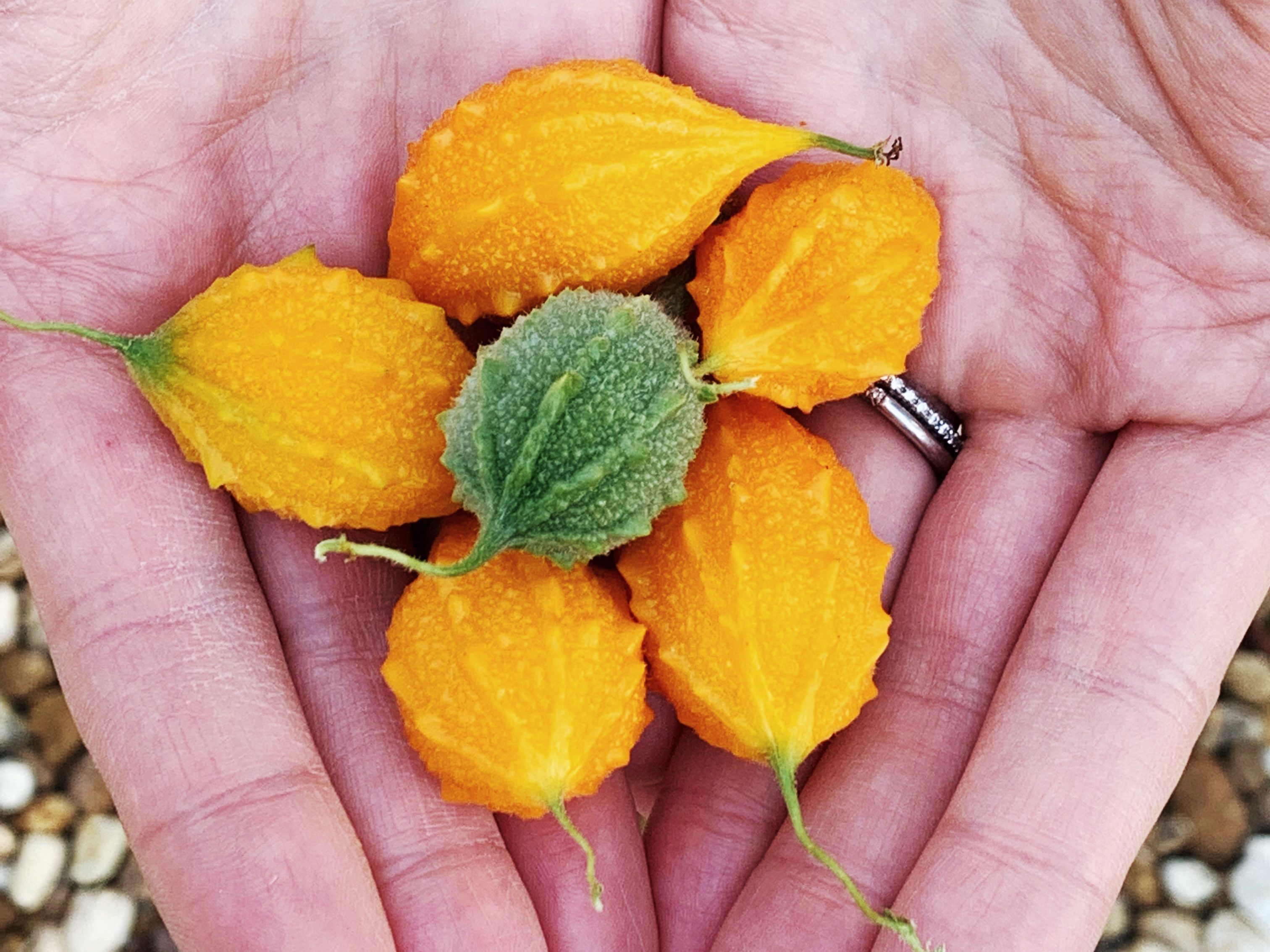
balsam apple pods in my hands

A funny thing happened on the way to the drug store…ah, this is so me. We were on vacation in the Florida Keys, and I took a short walk across the street to pick up a few things at the drug store. I stopped to admire a pretty bush with silvery leaves, and something bright caught my eye. A neon orange, spikey fruit called the balsam apple dangling from a vine. I had to know more.

Bright orange balsam apple hanging from vine. Poisonous

When I came back from my walk, I searched the web for more info. Then, I went back to the bush and collected samples of the vine, fruits and seeds. You don’t think the drugstore would mind that I borrowed their weeds, do you? I had so many questions. What are the uses? Is it native to the US? How did it get there? Is it historic?

The scientific name is Momordica balsamina. That is only important if you feel compelled to buy seeds. It’s not an apple, and you don’t make balsamic vinegar from it. If you grew up in Asia or Africa, you might know this herb or one of its close cousins, like the bitter melon. It is used as a herb or a vegetable in some Asian and African nations, but balsam apple is pretty much unknown in the US.

It is historic though, even in the US. Thomas Jefferson grew balsam apples at his experimental garden at Monticello. I’ve read a few books about that garden. In addition to eating the leaves and unripened pods, our ancestors used balsam apple to treat wounds. Sadly, most of the knowledge about how to use it to treat wounds has been lost to time. The former president was a big fan of flowering vines, but the plant is not native to the US. It is believed to have originated in Africa.

Little yellow flowers of balsam apple

Unique look

Balsam apples are so ugly, they’re beautiful. The vine is long and straggly. The balsam apples themselves begin life as adorable little yellow flowers, which become lumpy, warty green fruits. If left to ripen, the green fruits turn neon orange and squishy. When they open, there are three rows of sticky, wax-covered red seeds inside. You can see some of the sticky wax on my fingers in this photo.

red wax covered seeds of the balsam apple

How to use a balsam apple

Young, green fruits and leaves can been eaten raw, stewed or fried. While I wouldn’t recommend eating random vines you find growing on the side of parking lots, I did taste the leaves. They’re bitter. Really bitter. Even though I enjoy strong flavors, I am not so sure about eating any quantity of balsam apple raw. And there are some warnings

Do not ever eat the seeds or the ripe, orange fruit. It is poisonous and can cause vomiting and diarrhea. Avoid ingesting balsam apple if you are pregnant, for fear of causing miscarriage. That really freaks me out. I would avoid balsam apples and bitter melons entirely if I were pregnant or planning to be pregnant.

Ashley at My Heart Beets wrote a funny post and recipe for the cousin of the balsam apple (even though she refers to bitter melon as balsam apple, it isn’t, but they’re close). She compares the flavor of bitter melon to a potent beer.

However, this recipe for Cassava root and balsam apple sounds pretty intriguing. Here, the leaves are used as an herb to flavor the dish than as the bitter, pungent star of the meal.

balsam apple pods in my hands

Should I sell balsam apple at my farm stand?

Referring back to the whole concept of farmstand culture, if you have a farm stand that serves people from Africa or Asia, especially India, China, Mozambique, Nepal, or Vietnam, you might consider growing balsam apple or bitter melon. Start asking your neighbors if they would be interested in this mostly forgotten herb.

When they’re in stock, you can snag a pack of seeds here. Once you grow the balsam apple vine, you should be able to harvest plenty of seeds for future plantings and never need to buy seeds again.

Considering its strongly bitter flavor, balsam apple would be a tough sell to people who did not grow up with the herb, like most Americans. It will attract a ton of attention, but you’ll have to do a ton of educating. You could try one of my recommendations to increase your farm stand income and pair a small pint of green balsam apples with a recipe. Your patrons will need more information and ideas.

Remember, once ripe, the orange balsam apples are dangerous and should never be sold. If you don’t harvest them when they are very young and green, do not sell the fruit to your farm stand patrons. I would include a warning about the risk of miscarriage, which is likely a big buzz kill for your farm stand customers.

The plant is pretty prolific. You should get a lot of unripe, green balsam apples from each vine, and, but be careful, as the residents of South Florida have discovered, the plant can become a bit invasive. It’s not hard to weed out; it’s a pretty simple vine. I’d say, oh I don’t know, chives are a much bigger problem if they go to seed.

An introduction to balsam apples, a cousin of bitter melon, that grows wild in warm, tropical climates. Balsam apples were popular...so popular a US President grew them in his garden...but are now mostly forgotten.

Future of balsam apples

Once a featured conversation-starter in a president’s garden, balsam apples now grow in complete anonymity in the bushes along the drugstore parking lot. It is a rare and fascinating herb. One that deserves more study. What properties made it so attractive to our ancestors to use to treat wounds? The true benefits and risks of balsam apple vines remain mostly a mystery.

As an Amazon Associate, I earn from qualifying purchases.

Balsam apple opening sticky red seeds
Posted on 14 Comments

DIY coconut sugar scrub feels like you’re on vacation

Three ingredient DIY coconut sugar scrub

What was the first thing I did on vacation? Made this DIY coconut sugar scrub! My all-natural, homemade scrub for face and body uses only three ingredients to keep your skin soft and exfoliated.

Every December my dad, husband, kids and I fly to the Florida Keys. We love the swimming, restaurants, dive bars (this one’s kid friendly), and surprisingly rich history of Key West. Did you know the tiny island has three Civil War era forts? But, sun, fun, salt water, chlorine, a/c and long walks on sandy beaches can dry out your skin. Especially, delicate New Englander skin that has been protected under layers of clothing for three months.

Benefits of a sugar scrub

Sugar scrubs are all-natural and work better than just constantly slathering yourself in store-bought lotions. They can be used in the shower to help lock in all-day moisture. It depends on your skin and climate, but for some people, a sugar scrub in the shower replaces the need for face cream and body lotion. It could be an all-in-one.

My DIY coconut sugar scrub is vacation-themed and uses three simple ingredients you can pick up at the corner drugstore, small market or grocery on the first day of vacation. I did! Since coconut oil is solid at room temperature, you can easily pack these ingredients in a carry-on or pre-make the DIY coconut sugar scrub before you travel.

Most of us have used body lotions without reading the ingredient list. Well, even if we stopped to read the ingredients, would we understand them? I am an avid reader of skin care ingredients, and I am always encountering some chemical or preservative that’s new to me. DIY body scrubs are made with simple ingredients you can pronounce…and probably already have on hand.

Is coconut oil safe?

Great question. If you have never used coconut oil in your skin care routine or are unsure if you have an allergy to it, test a patch of skin before you slather yourself in coconut oil.

For the vast majority of people, coconut oil is safe and wonderful for your skin. However, there are some people who develop a skin allergy to coconut oil. I know several of them personally, which is why I wrote this other post to encourage people to be mindful even when using natural ingredients in their skin care routine. Test before you slather.

Is coconut oil safer than a lotion that’s full of chemicals? I think so. There’s always one person in a group who says something to the effect of “chemicals are delicious” or “I prefer the chemicals.” But, most of the people who spend time at natural lifestyle blogs are not ‘that person’.

Three ingredient DIY coconut sugar scrub

DIY coconut sugar scrub recipe

Ingredients:
60% granulated cane sugar
40% unrefined, organic coconut oil
(optional) squeeze of real lime juice

Why am I showing the recipe as a 60:40 ratio of sugar to coconut oil? If you are on vacation, you might not be able to measure exactly. I want to emphasize that it’s more sugar than coconut oil. That’s key to any sugar scrub. It’s usually a lot less oil than people imagine.

Unrefined coconut oil is less processed, which is why I recommend it. With less processing, more of the original properties of the coconut meal are retained, including a bit more of the sweet scent of coconut.

The acid in the citrus adds a little extra exfoliating, helping to clear away old, dead skin cells and bring out fresh cells underneath. If you have sensitive skin, you may want to skip the lime. As always, test your skin’s response before you rub your whole face with the scrub.

Need some ingredients? Want them delivered conveniently to your house while you are out living your life? Consider using my affiliate links for even more convenience. When you click on these links, you support this blog at no additional cost to you:

Safe storage

If you are going to keep a sugar scrub in your shower, please use a plastic container. I know glass is more eco-friendly, but reusing plastic containers is a smart way to store your sugar scrubs in the shower. Glass is dangerous in a tiled bathroom. Broken glass in a shower – with all those tiny, invisible shards – is a nightmare. Be careful.

Any other warnings?

Hummm, I’m guess I’m a cautious person. Just looking out for you.

Let’s review:

1) Test coconut oil on your skin first
2) Use plastic, not glass for safer storage
3) Be careful, the shower floor could get slippery

On that last point, in our old house, my shower floor used to get slippery all the time when I used homemade sugar scrubs. For some reason, my shower floor doesn’t get slippery in our current home. Maybe it’s different tile surfaces?

Either way, be careful to check and see of your shower floor gets slippery from the oil in the sugar scrub. If it does, just put a little soap in your hand and rub it over the floor to clean it a bit after you use the scrub. Warn anyone who might go into the shower after you that the floor could be a bit slippery.

Enjoy your soft skin

In a few quick steps, you’ve made an all-natural DIY coconut sugar scrub that should make an instant difference in your skin.

With daily use, your skin should be softer and better moisturized. And, your wallet should be healthier too. No need to spend any additional money on expensive, store-bought lotions!

Posted on 13 Comments

Two common diy skincare ingredients you should think twice about

hand holding coconut oil sugar scrub

Did you ever have an unexpected reaction to a natural ingredient? Probably. People do all the time. The way a person’s system absorbs…or rejects…the compounds it comes in contact with is unique. While natural ingredients are wonderful, they are not risk-free. I can speak from experience. Here are two common diy skincare ingredients that are usually but, not perfectly, safe and how I found out.

It’s not all that surprising that we all process things differently. Think about your own family. You’re genetically related; yet, your Aunt says onions don’t agree with her. Grandpa avoids lactose. Your niece has a nut allergy. Your sister feels great since she’s gone gluten-free. One of your twin cousins is up all night if he drinks coffee, the other can down an espresso and crash on the couch for 12 hours. Or some similar scenario. You’re all processing natural foods differently.

The same is true when it comes to the natural ingredients you rub on your skin.

I mentioned that I had my own experience with this. Yes, me. Even a natural lifestyle blogger had to tone down my usage of a certain essential oil, but we’ll get to that in a minute.

Here I am highlighting some of the dangers of two super common all natural ingredients you will see everywhere. Don’t avoid them, just think twice before you use them. Test them on a patch of skin. Be mindful when you use them. Be aware of how your skin reacts and that changes can occur over time.

The first occasionally-allergenic ingredient is…

Coconut oil

Cue the gasps.

The darling of the natural skincare world. Coconut oil is the base ingredient in an unbelievable number of Pintrest skin care pins. It might actually be the most common natural skin care go-to.

Widespread popularity is precisely the reason I am introducing the idea that coconut oil is not 100% fail-safe. The absolute worst time to learn that you are allergic to coconut oil is immediately after you just slathered yourself in a coconut oil body scrub.

Most people will tell you to use coconut oil on your skin and your baby’s skin, and everything is wonderful. Yet, I personally know two people with an allergy to coconut oil.

Coconut oil allergies are uncommon but do occur. They are not the same as tree nut allergies. If you were thinking that you would not be sensitive to coconut oil because you are not allergic to tree nuts, well, it turns out that those two allergies are not related.

What should you do?

The vast majority of people reading this post are not allergic to coconut oil; however, some of you will find that coconut oil clogs your pores or causes mild breakouts. And a few of you will realize overtime that you are so sensitive to coconut oil, it’s probably actually an allergy.

If you are not allergic to coconut oil, consider yourself lucky. It’s a wonderful, mild moisturizer that makes wonderful body scrubs and DIY skincare. If you haven’t tried coconut oil in your everyday skincare routine, test a patch of your skin to be sure you’re not allergic, and then, try my favorite, simple DIY recipe…

My favorite coconut skincare recipe is just unrefined, organic coconut oil mixed with sugar. In a pinch, you can use baking soda as well. If you have lime essential oil or a fresh lemon or lime, squeeze in a few drops. It smells delicious, and citrus and sugar make a natural glycolic acid. You can use this simple, effective coconut scrub on your face and body everyday in the shower. I find that it keeps my skin smoother than any store-bought product.
As an Amazon Associate, I earn from qualifying purchases.

Coconut oil with a coconut

Lavender essential oil

Oh this is not going to go over well. What could I possibly have against lavender essential oil? It is the world’s go-to miracle for sleeplessness and healing burns. Yeah, I know. It’s a wonderful oil. It’s gentle enough to be in tons of baby products. I really do like it. But, remember how I mentioned earlier that I had my own unexpected reaction to a natural skin care remedy?

My sister started selling essential oils about five years ago. Click here to visit her essential oils site. She told me a million times I had to try them. She said I’d love them. She couldn’t believe I didn’t already have a cabinet full of essential oils. It’s so up my alley. All true.

She studied the benefits and uses of each essential oil better than she ever studied for a class. She flew with her infant across the country to attend a conference. She was serious. And, she really enjoyed learning about the lesser-known uses for essential oils and sharing those with her friends and family.

DIY skincare warning

Lavender is often used in face oils for anti-aging. It’s a common ingredient in face creams, both DIY and store-bought. One of the lesser-known tips my sister found claimed that you should put a drop of lavender essential oil in your mascara to make your lashes grow long and lush.

I thought it was all great. I added lavender essential oil to my face creams and mascara. It made even the cheapest drug-store mascara smell like a luxury product. And my eyelashes…fell out. The exact opposite of what was supposed to happen.

At first I thought it was a fluke. I did not make the connection between my use of lavender on my face and eyes and the shedding of my eyelashes. To confess, it took me months and several delusional re-tries with the lavender in my creams and mascara to figure it out. But, the same thing kept happening. First, my lashes became patchy. Then, with continued use, I lost 40% of my eyelashes. It was noticeable.

selective focus photo of bottle with cork lid
Photo by Mareefe on Pexels.com

What did I do?

Mascara didn’t do me a whole lot of good when I was missing eyelashes. But, it still took me more than a year to be 100% sure why my eyelashes were falling out. How was I sure? I changed everything about my routine. I stopped using the face cream. And then, I switched to a new mascara, no additives.

My eyelashes slowly started growing back. It turns out, the only thing less attractive than missing eyelashes, is the spikey regrowth.

Now, I’m not saying that everyone will lose their eyelashes if they use lavender in their face products. In fact, you probably won’t, and if you do, it’s not serious…unless you’re an eyelash model, in which case you should put your resume together.

Back to my example of genetically-related people experiencing natural ingredients differently. My sister does not seem to lose her eyelashes when exposed to lavender essential oil. It’s just me. I am the only person I know who ever connected eyelash loss with lavender. Go figure.

Would you like to test fate?

Don’t avoid coconut oil or lavender.

Just don’t take for granted that they are safe because they are natural.

Tips for smart, safer use of natural skincare:
1) Test a patch of skin before you slather yourself
2) Be honest with yourself if you have a reaction (don’t live in disbelief like I did)
3) Pay attention over time because you might develop a reaction

Pick up some ingredients

If you want to make a sugar scrub with coconut oil, you can pick up the ingredients pretty cheaply at the grocery store or buy them on Amazon. I recommend unrefined, organic coconut oil. It is the least processed and preserves more of the natural properties of the fruit. (Yes, coconut is generally considered a fruit.) Use cheap granulated cane sugar. Turbinado aka raw sugar is too rough. If you have baking soda in your kitchen, you can substitute that instead of sugar.

Keep scrolling to use my quick links and have the ingredients shipped directly to your house.

If you have a little extra disposable income, you can try adding in a few drops of lime essential oil. It’s pretty expensive though. You can just squeeze in a drop of lime juice from the real thing. Just warning you, the scent will be absorbed into the coconut oil for the most part.

Lavender essential oil is also a wonderful product. I still use it. I just use it more carefully than I did before.

You might also enjoy this article on why I prefer to use sugar in a scrub rather than coffee grounds.

Posted on 3 Comments

3 new ideas to increase your farm stand revenue in the new year

Orange bag full of farm stand fresh root vegetables beet radish parsnip celeraic

Farm stands can be simple little tables at the end of your driveway. They can be elaborate set-ups at farmers markets or fancy sheds on the roadside. Regardless of the size of your farm stand, are you maximizing your revenue? Here are three new ideas to increase your farm stand revenue.

Should I care about revenue?

Hey, it’s your farm stand, you can give the food away if you want to. The thing is, in order to keep human beings motivated over the long-term, some positive reinforcement works best. If you don’t need the money and can get enough positive reinforcement to keep your farm stand going without revenue, that’s awesome. Most people need some form of revenue in order to maintain motivation or just to pay for stuff. Hence the reason this blog has a couple of disclaimers about occasionally linking to Amazon or another affiliate partner.

As an Amazon Associate, I earn for qualifying purchases.

#3 Plan for a longer season

In economics there is a concept called marginal cost. Marginal cost is the cost of producing one more unit of something. It’s incremental, an additional cost, as opposed to looking at the total cost of a project. Once you’ve spent the money and time to set up a farm stand, a method of payment, and grow the produce, extending your season only represents minimal marginal cost.

One way to extend the season is to offer frozen herbs in serving-size bags. Let’s face it, when given the choice of fresh herbs options during the summer, sage is not a big seller. But, it freezes really well. If you have some freezer room, you can freeze little bags of herbs like sage, parsley, thyme, mint and chives for a few months and use them to stock a winter farm stand. The cold weather actually becomes an advantage for frozen herbs. I’d still put them in a cooler on your farm stand table for protection from the elements.

Farm stands don’t have to be stocked with produce alone. To extend the season, consider offering wreaths, soaps or candles.

If you or someone you know has a few grapevines or hearty evergreens – like boxwood or cedar – you can make wreaths and mantel pieces at low marginal cost! Start today and adapt them to the season.

If you’re willing to buy materials, you can even make wreaths with inexpensive burlap that will last longer than the evergreen wreaths. Burlap feels very ‘farm stand’. Here’s a tutorial from The Busy Bee. Accent decorations, like pine cones, should also be easy to pick up for free. Consider adding bayberry or holly bushes to your landscaping for some future accents for your creations.

Candles don’t all have to be poured into mason jars or molds. How beautiful would your winter farm stand look with hand-dipped candles hanging from the ceiling? Classic and classy. I got into making hand-dipped candles a few years ago. Do you remember doing this as a kid, maybe at a nature center or an historic house tour? If you’re in the mood for a little DIY, making your own candles isn’t as hard as it seems. It does take some time to melt the wax and dip-dip-dip-dip, etc…you get the idea.

white candlestick with flame
Photo by freestocks.org on Pexels.com

#2 Add pay options

We are in a transition period. Some people grew up in a generation where farm stands were “cash only“. Other people grew up in a generation where you can pay with your phone at most of the places they shop. That second group is starting to forget to even bring cards and cash with them (me, guilty).  If you want to maximize your potential revenue, your farm stand should accommodate everyone and their payment methods.

Like what? No, I do not recommend accepting Bitcoin at your farm stand. Virtual currencies are too volatile. However, any of the popular apps for payment processing should work pretty well. I am not sure yet if the easiest cash alternative is a payment app or credit cards.

You can set up credit card processing through any online vendor, your local bank or Square. As you start to look at your options, check the small business services for the bank you already use first and compare other options to their offerings.

If you run your farm stand on the honor system – in other words, unstaffed – your only alternative will be to use paypal.com or venmo.com for small business. Review their options and see what payment service might be right for you.

Don’t forget to advertise that you accept multiple forms of payment. Adding payment options removes a barrier for your customers. Put up a sign at your farm stand right away. Add a note to your website. It takes away excuses like, “I don’t carry cash” or “I don’t have exact change.” Remove barriers like these to drive more sales at your stand over the next year.

photo of black flat screen monitor
Photo by Fancycrave.com on Pexels.com

#1 Include recipe cards!

By far, this is the easiest way to drive more sales and the Number One thing farm stand owners neglect. Put yourself in the shoes of your customer. Imagine that you’ve never seen a ground cherry before or never tried to cut up a butternut squash. What do you do with it? Why should you buy it?

I would love to tell you that all of your customers are finding my Butternut Squash and Apple Soup recipe and know just what to do with those odd, rock solid squashes, but they’re not.

Put little recipe cards next to your fruits, herbs and veggies. Make little signs to put up next to your baskets of produce to draw attention to the recipe cards. Make it part of your advertising. It will set you apart from other farm stands, even at a farmers market where there’s lots of competition. You customers will start to browse the free recipes along with the produce. Change the recipe cards to drive repeat sales.

The great thing about this idea is you can complete the task in one day with very little additional effort. Just go to Pintrest or your favorite search engine, enter the name of your veggie and “recipe” and hit search. You will get a thousand+ ideas instantly. In fact, you can save yourself even more time by entering the name of the produce and “free recipe printables”.

Printables are fancy, ready-to-print designs that other people – usually bloggers like me – created for you. One big downside to the ready-made printables…

…free printables won’t be branded to your farm stand. They might not have your same farm stand branding colors, and they might not have a place to put your logo. They won’t be instantly recognizable to your customers as having come from your stand.

Two ideas about recipe card branding:
1) type out some recipes and design your own branded recipe cards
2) look for “free recipe printables” that are also blank and add a sticker with your logo

What do you think? I hope you had fun reading about how to increase your farm stand revenue in the next year. Leave a comment and let us know what you think about these three ideas to increase your farm stand revenue. Do you have another idea to share? Share away!

Are you ready to do some shopping of your own? Try the Handmade Marketplace at Amazon.com.

Posted on 16 Comments

Why do I make life harder on myself?

Zoomed in on woman's eyes

Do you tend to make choices that differ from the “norm”?  It makes your search purpose harder. I have to come clean with all of you…

in that, I have this habit of choosing the road less traveled. Well, that’s one way to put it.

There’s this guy at work who always edits my commentaries with “just say what you mean, Tiffany”, which is…that I pretty much consistently choose to do things differently, and in the process, I make things harder on myself.

Do I thrive on that? Guess that’s one interpretation. Any psyche majors reading this? That deserves a smiley face emoji.

smiling emoji
Photo by rawpixel.com on Pexels.com

Say what you mean

My choices often stand out from the crowd. Like…my major wasn’t business > wasn’t finance > it was Real Estate Finance.

And, back when I was in grad school, I went for an interview for a summer internship. Oh, I should explain about the importance of the SUMMER INTERNSHIP to MBA candidates.

Securing a fabulous summer internship is the goal for an MBA student during her or his first year of studies. When you are getting your MBA, you and your peers spend a lot of time talking about your internship goals, timing and dreams. If you land the right internship, you can plot your career course and earning potential.

Back on topic: once while I was at an interview for a summer internship, my potential employer left a printout of the interview schedule down on a table in front of me then left the room. I saw that I was the only one interviewing for a research internship. Sounds like evidence of the road less traveled, at least it was more than a decade ago when I was in grad school.

Things worked out well for me. Oh, no, I didn’t actually get that job. Yeah, I was surprised, too. But, a good friend did, and I ended up with an internship in NYC. Which was great, because I got “living in a big city” out of my system when I was young and have enjoyed my retreat back to the Connecticut countryside ever since. Like really enjoyed it, like I have homestead envy.

What happened to make me question my approach now?

Considering the big picture…I’m probably questioning my approach right now because I’m facing a life transition as I finish doctoral classes, wrap up my dissertation and think about “what’s next”.

But, then again, it’s really a reflective time for all of us, isn’t it? The year is ending. We are all making plans for a new year, new phases of life, and thinking about purpose.

In a class last weekend, we had a long discussion on exploring purpose. The theme of the day’s lesson was: What is a professor’s purpose? But, you don’t have to be studying to be a professor for this to resonate. Insert any other role you fill into that question.

I guess that discussion stayed with me.

Hearing more about what was on my classmates’ minds about their purpose, how your purpose changes, how we all go through phases when we think more or less about it. The quiet time after the holidays – as the new year is starting –  is a pretty reflective time for most people. Possibly, it’s a time when we think more about purpose.

What’s on your mind as we approach a new year?

Don’t get me wrong. I’m not wishing this year to end. I try never to wish time away. It’s too precious. Doesn’t mean I don’t plan for the future though.

What are your personal goals for the new year? My biggest goal for the new year is to recommit.

For the past three years, my attention has been split between too many things. In the new year, I want to be more deeply involved in my kids’ sports and clubs. I want to be that mama who’s coordinating snacks and singing songs with them in the car on the way to practice. In the new year, I want to follow through on more dinner plans with my husband. We thought we would never slow down, even after having kids, but we did. Forget that. Let’s keep that in the past-tense. We should reconnect over a quiet date night a little more often. And, then there’s my career. In order to go back to school part-time, I had to carve some time out from building my career, and in the new year, I want to devote a little more energy to my work.

Bonus thought: Guess what? For the gardeners among us, the dawn of a new year means we get to start planning a new layout, choosing new seed varieties, and feeling Spring fever again soon. Holy cow, I get Spring fever like crazy after the turn of the year. Seedlings, here we go again.

Ok, and the blog?

Of course, this blog. It’s been an amazing start. Thank you for being a critical part of it! You are reading this, and I am appreciating you for it. I hope something resonates in your search for purpose.

I’m committed to bringing you new articles, new perspectives and the play-by-play of the construction of a new window garden in the new year!

At the time I’m writing this post, I have 35 draft posts in the works. My blogging platform does me the kindness of showing me that number, at the top of my screen, every time I open my dashboard.

Oh wow, I guess I have a choice. Those 35 outstanding, half-written, partially-researched, mini-works of blog art could weigh on my shoulders like 35 bricks…OR, I can think of them as 35 bricks in a walkway, a path we can lay and follow in the new year. One of those choices is a lot more appealing than the other. It’s the same thing, just reframed. Like, black cats on your brick walkway could just be adorable kittens who want to play. No bad luck required.

black cat on a brick path

How about your blog?

Do you have a blog? Please leave a link to it or a recent article in the comment section. We’d love to see your labor of love and support you in the new year!

I know it’s not always easy. There are days when things seem to be moving in slow motion, and it’s frustrating.

At least you can always feel welcome to retreat to this community to share your ideas and be supported. I’m happy to help you find ways to reframe the frustration and look forward to the virtual conversations we’ll have as we all begin a new year.

Posted on 4 Comments

Tips for Hot Process Soap Making Beginners

Once. I admit it. I bought all the stuff, designated a hand mixer and a stainless steel pot, and made soap from scratch with my sister, just once. Now the soap-making equipment sits in my basement. But, after reading this post on hot process soap making, I’m starting to feel inspired to get another batch going. It’s really a fun bonding experience, as long as you have patience. Homemade soap takes about a month to cure before you can use it. We did not use a crockpot, but I really like the idea. A professional soap maker on Twitter assures me she uses a crockpot. It’s not cheating.

Check out this pressed article from Natural Beauty Workshop for more about hot process soap. Source: Tips for Hot Process Soap Making Beginners

Posted on 5 Comments

DIY dry shampoo for red hair

One of my coworkers confessed to me that she tried a store-bought dry shampoo and just didn’t feel like she used it right. It either left white residue in her hair or wore off midway through her day. Meanwhile, she had to breathe in a dust cloud of aerosol spray just to use it. There has to be a better way. As a lover of all things natural, including hair care, I felt inspired to find an easy recipe for DIY dry shampoo for red hair that worked.

Looking for a different color?

for brown or auburn hair click here
for blonde hair click here
for black hair click here
for white hair just use the cornstarch alone

My personal test of homemade dry shampoo

On Thanksgiving morning, I got up early to finish making a blueberry pie. This is a true story. The rolling, mixing and baking took longer than I thought it would. By the time I finished the pie and looked at the clock, I only had 20 minutes left before we had to leave.

Now we’re all in a rush, and my second-day hair was in need of some attention. All day, I would be hugging relatives and taking family photos. My hair should at least look and smell fresh.

In the past, I’ve used trial-sized, store-bought dry shampoos, but we didn’t have any in the house. What I did have was some spices and cornstarch I bought for the pie filling. How skeptical are you right now? Probably about as skeptical as I was. But, with limited options, I took a risk and tried a DIY dry shampoo recipe that worked great! Read on for the full recipe and my review.

It turns out, homemade dry shampoo is fantastic! You can make dry shampoo with just a couple ingredients that are probably already in your kitchen pantry. For a lot of reasons, homemade dry shampoo is better than store-bought dry shampoo. Another great discovery…by just tweaking one or two ingredients, you can change the color of the dry shampoo. No more white dusty roots!

It is really shampoo?

Not really. It’s not foamy. It’s not liquid. It’s not washing your hair. You don’t rinse it out, but it’s not a leave-in conditioner.

Dry shampoo is a powder that you use to absorb oil, make your hair look fresh and add a pleasant fragrance to your hair.

Five reasons to use DIY dry shampoo

  1. Works great, absorbing oils and leaving hair looking fresh
  2. No chemicals harming your scalp or bloodstream
  3. No aerosol deteriorating the ozone layer
  4. Inexpensive, whip up one batch and store it (pretty much) forever
  5. Easy to make with stuff you probably already have

When to use dry shampoo

It might be that your hair is clean, but you used an oily sunscreen and just want to get rid of the greasy look that’s built up around your hairline. Maybe you didn’t have time to wash your hair or just don’t wash your hair that often, rub a little dry shampoo through it so it doesn’t look greasy or flat.

You can use dry shampoo whenever your hair feels a little oily or not quite fresh enough. As a bonus, the dry blend helps lift your hair at the roots and adds volume.

I tend to use dry shampoo before I style it, but it doesn’t matter if you wait until after you’ve styled your hair. You just want to make sure you can still rub the powder into the hair a little bit, which might depend on the style.

If your hair is in an updo or a tight bun, you will probably have a hard time rubbing the dry shampoo through and getting the powder to blend evenly.  In this case, you can try using a make-up brush to dust the dry shampoo onto your hair. On the other hand, if you just straightened or curled your hair, you shouldn’t have much trouble using dry shampoo after styling it, especially my recipe.

Will tomorrow be second-day hair? Try my DIY dry shampoo recipe for homemade hair care right from your kitchen. Only three simple ingredients blend right into your red or auburn hair!

DIY dry shampoo recipe for red hair

for brown or auburn hair click here
for blonde hair click here
working on a recipe for black hair
for white hair just use the cornstarch alone

Ingredients:
1 tablespoon cornstarch
1/2 tablespoon ground ginger
1/2 tablespoon ground cinnamon
(optional) arrowroot (can be used instead of or to complement the cornstarch)

Need to restock your spice cabinet? I partnered with spicesforless.com to make it easy. Their site is so pretty to click through. It’s like an art gallery for spice lovers. They will have any color or flavor spice you might need.

Directions:
Mix together the cornstarch, cinnamon and ginger together.
Since we all have different hair colors, you might have to play with the color a little bit by adding a little more cinnamon for darker shades or a little more ginger for strawberry blonde or lighter hair tones. If your hair is more auburn than red, click here for a dry shampoo recipe for brown/auburn hair. Don’t worry. It doesn’t need to match your hair exactly.

Store in almost any convenient container or baggie.

To use:
Dip your fingers into the DIY dry shampoo.
Dust off any excess powder.
Your fingers should now be lightly coated in dry shampoo.
Rub shampoo dust through your hair at or within 2-3 inches of the roots.
Use the same motion you would if you just took your hair out of a ponytail and are trying to loosen up the roots.
Repeat all over your head. Pay special attention along the hairline, above and behind your ears.
Do not get the powder in your eyes. It might burn.
The shampoo should absorb oil and blend into your hair in seconds.
Your hair will have a light fragrance of cinnamon and ginger.
The cornstarch will help add lift and volume.
It should last all day and night.
Be careful if you are wearing a white shirt. Like any hair product with color in it, you might get a dusting of reddish specks on you if you are wearing a bright white shirt. As an alternative, just put a towel over your shoulders.

What happens when I rinse it out?

When you do go to wash or rinse your hair again, there is the faint scent of cinnamon and ginger root in the shower. Nothing else really happens. It rinses right out of your hair.

Please leave a comment and let us know if you’ve tried DIY dry shampoo. What do you think?

Looking for more DIY skin and hair care? You’ll find more of it here. I love this stuff.

DIY coffee scrub
3 reasons I just cannot get into coffee-based body scrubs
Top 5 handmade soaps – inexpensive!
Skincare advice from 80 years of glowing skin

Done with DIY for the time being? Then, I will share with you a convenient place to buy other people’s DIY’s. It only takes a few clicks to search verified handcrafted sellers on the Handmade Marketplace. Click the banner below. See what you think.

Posted on Leave a comment

Gifts for kid gardeners – all gifts under $20

Let’s get the kids started early! These gifts for kid gardeners are interactive, educational and help teach patience. You can feel good that you aren’t just adding to the buckets of toys. Your gift can stand out and stand the test of time.

If you enjoy “theme gifting” for a family, gardening is the perfect theme!

Keep scrolling to find gift ideas for children of all ages, from babies to teens and all in-betweens. Some of these ideas would work for grown-ups, too, but that wasn’t my focus when I researched this list.

I put the work into compiling this collection of great gardening gifts for kids because, well, I’m buying these gifts for the kids in my life, too. As you read through, I’ll let you know in the comments if I bought one of these gifts or if we already have it.

It was a lot of fun to put this together. My imagination goes wild when I see these ideas. I hope you have fun scanning through this ultimate list of gifts for kid gardeners.

As an Amazon Associate, I earn from qualifying purchases.

A few tips to give you the best experience possible:

Just click on the photos to get more details and to see the prices. When I put this list together, all of the items were under $20. TIP: Make sure you read the expected delivery date before you place orders to be sure it will arrive in time! Check to see if you need seeds or if it already comes with seeds and soil.

If you need seeds for any of these gifts, I recommend these organic micro-greens for kids. TIP: Organic micro-greens are mild, sprout quickly and can be eaten right away. You can pour 50 of them into a little cup and most will sprout. Other herb seeds, like basil and parsley, are much more recognizable, but they take forever to grow.

More than 20 unique gift ideas for kid gardeners

Ok, enough of my tips and thoughts…here’s the ultimate gift list for kid gardeners:

Real, tiny succulent in a necklace


Whether the kids you are shopping for are five or fifteen, this real-life succulent growing inside of a tiny necklace is sure to be unique and memorable! I’ve never seen anyone with anything like this. Bring the garden with you wherever you go.

Terrarium


We have this toy! My kids loved it. First, they decorate the plastic jar. Then, they plant the seeds and watch them grow. You get enough seeds to grow the garden twice. TIP: to make the stickers glow in the dark, hold the jar up to a lightbulb for 10 seconds.

Baby book with a gardening theme


Perfect for those adorable little chubby fists to grab at this book. Baby can use all of her or his senses exploring these soft, interactive pages.

Grow plants and see the roots


A root viewer garden takes window sill gardening to the next level. Your kid gardener can see what’s happening above and below the surface of his or her garden. That actually gives them something to look forward to when the outdoor garden season ends.

For a toddler – Garden stickers for bathtime


Don’t worry. There’s nothing sticky about bath tub stickers. When these squishy foam flowers get wet, a toddler or young child can stick them to the tub or tile walls. I wouldn’t recommend this gift for a small baby. They might bite through the foam.

Great author for a gardening book

Here’s one I must have for my kids. We love reading books. We love gardening. Let’s put the two things together and imagine a garden in the world of wonderful rhymes and rhythms!

Complete grow kit

A little garden in a cup. These peas will sprout pretty quickly. The kids will think it’s a ton of fun. But, just to set your expectations, the plants likely won’t grow long enough to become edible pea pods.  It’s possible because peas don’t need a ton of light, but the chances that a kid will keep them watered and cared for long enough…low.

TIP: If you really want a garden the kids can eat quickly, keep scrolling an choose a DIY window garden, egg carton with grow lights or the stackable countertop garden with organic micro-greens.

Fairy garden


Who wants a plastic garden when you can have a plastic-live plant hybrid? Imagination goes wild!

Engineering a flower garden


Any gardening gift could be considered a STEM or STEAM gift (Science, Tech, Engineering, Art, Math), but this is a double-whammy build-able gardening gift with a heavy engineering component.

DIY Coloring Pillow Garden Scene


My kid would spend hours coloring in every little garden detail of this pillow. It’s a fun craft that becomes a useful pillow. Sounds like a win-win.

How do I buy one of these gifts?

Just click on the pictures!

Farmer’s Market board game


My kids beg for family board game night. Here’s a game for ages 3+ that brings the garden theme full circle to my favorite place…a farm stand!!  Double exclamation points for the first farm stand idea in my list of gifts for kid gardeners.

Grow light


No matter what time of year, if a kid feels the urge to grow plants, he or she can use this grow light. The light clips to a desk, table or chair. You might want to check Pintrest for craft ideas on how to make your own DIY planters. A couple of good ideas: egg cartons, plastic bottles, or disposable cups. Don’t forget to add a little sack of seeds.

Blocks that make flowers


Genius twist on the typical kid gift…blocks. These creative blocks grow into a mix-and-match garden. No messy soil for the parents to clean up.

Click on the pics to buy the gifts.


A doll with a garden and a farm stand!


You may be more familiar with her big sister, but this little set is the second farm stand themed toy on my list of gifts for kid gardeners. I love it. When I first saw it, I thought, “this is the perfect gift for all of my little farm stand lovers!”

750-piece Farm Stand puzzle


Another farm stand themed gift, a puzzle. Hey, I admit it. A puzzle is just an ok gift. Unless you catch a kid or a family who is really into puzzles. Like my dad and me! On my summer vacation to Cape Cod, I did two 1,000-piece puzzles. It’s a great way to spend quality time together.

Seed starter kit


If you’re going to get a seed starter kit, I’d say stay on the small side. There are 120-pod and 78-pod seed starters out there. Speaking from experience, that is so much work for the parents. This 24-pod seed starter is much more manageable. And, if the tray tips or gets knocked over, there’s so much less water to clean up.

Also, if you’ve been reading carefully, you know what I’m about to recommend…

TIP: Consider buying organic micro-green seeds instead of the totally tempting traditional herbs and veggie seed packets. Traditional herbs and veggies are great, but require a lot more care and patience than most kids have.

Best, most useful and tolerant live herb plant

But, if you love kids who have a 75% probability of not watering their plants enough, consider a live bay leaf plant. I love mine. L-O-V-E it. I forget to water it all the time. It doesn’t mind. It needs very little light, and you can add the leaves to soups, sauces, roasted chicken, and baked veggies. It’s not much of a gift, I know. We can fix that. Give them some creative craft supplies like stickers or decorative tape to decorate the container!

Farmer’s Market card game


The 750-piece puzzle I recommended a short scroll ago is way too advanced for little kids. But, this “learn your colors” farmer’s market puzzle would be great for the younger folks.

Secret Garden coloring book


Hidden within these intricate pen-and-ink garden scenes there are all kinds of little “treasures” to find. Good for school-age kids or older kids who are into the adult-coloring book craze.

Paint and plant garden


I promised to let you know when I was recommending something I was also buying. My daughter is 5 1/2. When I saw this gift, I knew she’d love to paint and plant a flower garden. Chances are, the flowers will never make it to a full bloom (marigolds take months in full sun), but the hand-decorated, farmhouse-style galvanized potter can be reused over and over.

Farm stand cart and market


Know anyone who loves lovable ice queens? The sequel to this famous movie is expected to come out in 2019, which means her popularity will go on and on for years to come. With this toy, kids can pretend this queen is just a humble farm-stand owner. Another great gift for my kids. Hint, hint Santa.

Seriously sprouting stacking mini-garden

Sprouts are great. As advertised, they sprout quickly. Kids can taste them, if they are a mild blend like this one. These four stackable trays are designed to save space and limit mess with super quick growing results.

Need more gift ideas. I recommend looking through a special site on Amazon.com called the Handmade Marketplace. Sellers in the Handmade Marketplace are reviewed by Amazon to be small, batch handcrafters. You’ll find lots of unique gifts from jewelry to goat milk soap to whiskey glasses and farmhouse ornaments.

To go directly to the Handmade Marketplace, click the banner above or stop by my latest review on the 10 best-selling handcrafted items on Amazon that aren’t booze glasses.