Posted on 59 Comments

Forgotten herb: balsam apple

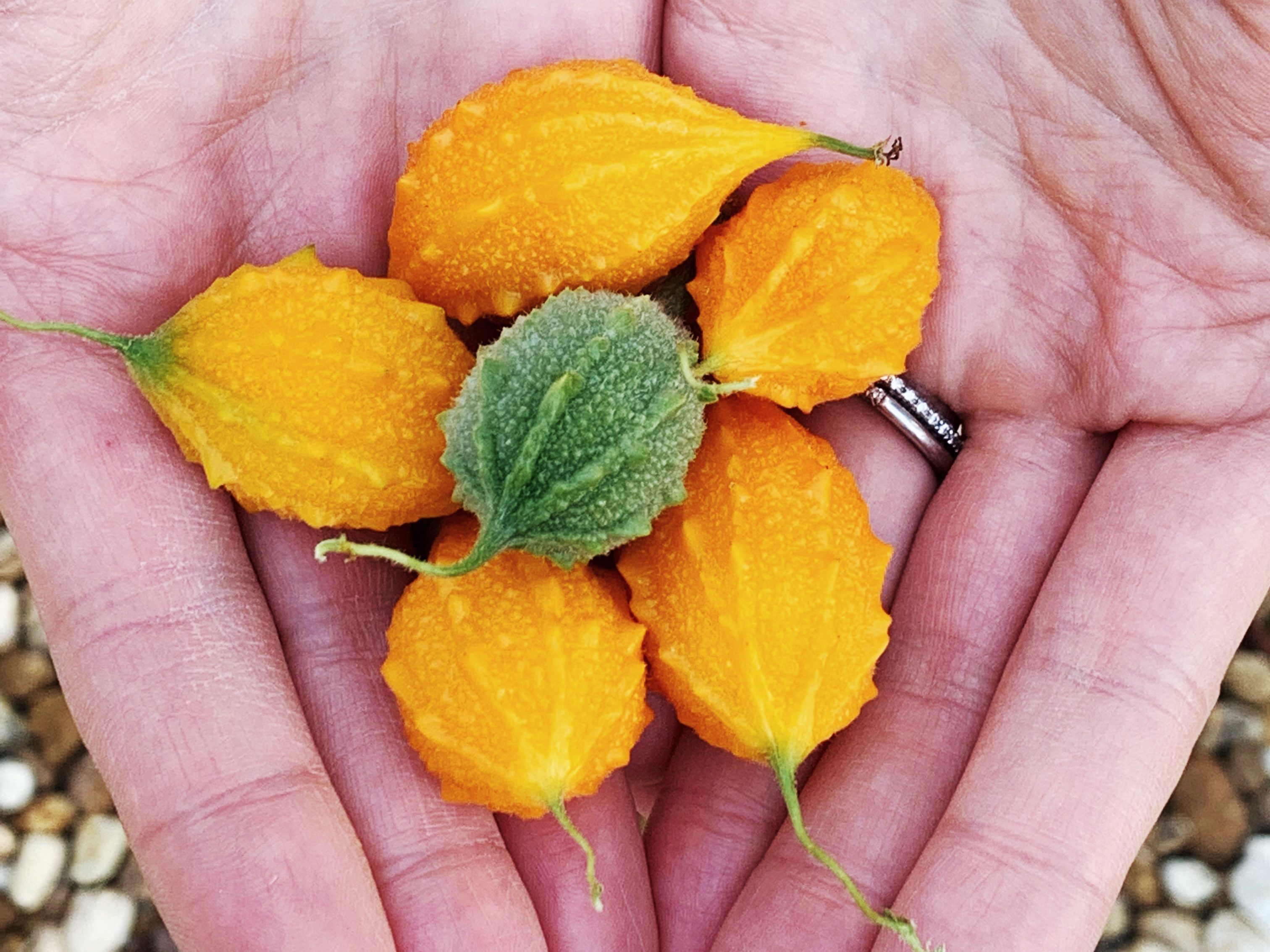
balsam apple pods in my hands

A funny thing happened on the way to the drug store…ah, this is so me. We were on vacation in the Florida Keys, and I took a short walk across the street to pick up a few things at the drug store. I stopped to admire a pretty bush with silvery leaves, and something bright caught my eye. A neon orange, spikey fruit called the balsam apple dangling from a vine. I had to know more.

Bright orange balsam apple hanging from vine. Poisonous

When I came back from my walk, I searched the web for more info. Then, I went back to the bush and collected samples of the vine, fruits and seeds. You don’t think the drugstore would mind that I borrowed their weeds, do you? I had so many questions. What are the uses? Is it native to the US? How did it get there? Is it historic?

The scientific name is Momordica balsamina. That is only important if you feel compelled to buy seeds. It’s not an apple, and you don’t make balsamic vinegar from it. If you grew up in Asia or Africa, you might know this herb or one of its close cousins, like the bitter melon. It is used as a herb or a vegetable in some Asian and African nations, but balsam apple is pretty much unknown in the US.

It is historic though, even in the US. Thomas Jefferson grew balsam apples at his experimental garden at Monticello. I’ve read a few books about that garden. In addition to eating the leaves and unripened pods, our ancestors used balsam apple to treat wounds. Sadly, most of the knowledge about how to use it to treat wounds has been lost to time. The former president was a big fan of flowering vines, but the plant is not native to the US. It is believed to have originated in Africa.

Little yellow flowers of balsam apple

Unique look

Balsam apples are so ugly, they’re beautiful. The vine is long and straggly. The balsam apples themselves begin life as adorable little yellow flowers, which become lumpy, warty green fruits. If left to ripen, the green fruits turn neon orange and squishy. When they open, there are three rows of sticky, wax-covered red seeds inside. You can see some of the sticky wax on my fingers in this photo.

red wax covered seeds of the balsam apple

How to use a balsam apple

Young, green fruits and leaves can been eaten raw, stewed or fried. While I wouldn’t recommend eating random vines you find growing on the side of parking lots, I did taste the leaves. They’re bitter. Really bitter. Even though I enjoy strong flavors, I am not so sure about eating any quantity of balsam apple raw. And there are some warnings

Do not ever eat the seeds or the ripe, orange fruit. It is poisonous and can cause vomiting and diarrhea. Avoid ingesting balsam apple if you are pregnant, for fear of causing miscarriage. That really freaks me out. I would avoid balsam apples and bitter melons entirely if I were pregnant or planning to be pregnant.

Ashley at My Heart Beets wrote a funny post and recipe for the cousin of the balsam apple (even though she refers to bitter melon as balsam apple, it isn’t, but they’re close). She compares the flavor of bitter melon to a potent beer.

However, this recipe for Cassava root and balsam apple sounds pretty intriguing. Here, the leaves are used as an herb to flavor the dish than as the bitter, pungent star of the meal.

balsam apple pods in my hands

Should I sell balsam apple at my farm stand?

Referring back to the whole concept of farmstand culture, if you have a farm stand that serves people from Africa or Asia, especially India, China, Mozambique, Nepal, or Vietnam, you might consider growing balsam apple or bitter melon. Start asking your neighbors if they would be interested in this mostly forgotten herb.

When they’re in stock, you can snag a pack of seeds here. Once you grow the balsam apple vine, you should be able to harvest plenty of seeds for future plantings and never need to buy seeds again.

Considering its strongly bitter flavor, balsam apple would be a tough sell to people who did not grow up with the herb, like most Americans. It will attract a ton of attention, but you’ll have to do a ton of educating. You could try one of my recommendations to increase your farm stand income and pair a small pint of green balsam apples with a recipe. Your patrons will need more information and ideas.

Remember, once ripe, the orange balsam apples are dangerous and should never be sold. If you don’t harvest them when they are very young and green, do not sell the fruit to your farm stand patrons. I would include a warning about the risk of miscarriage, which is likely a big buzz kill for your farm stand customers.

The plant is pretty prolific. You should get a lot of unripe, green balsam apples from each vine, and, but be careful, as the residents of South Florida have discovered, the plant can become a bit invasive. It’s not hard to weed out; it’s a pretty simple vine. I’d say, oh I don’t know, chives are a much bigger problem if they go to seed.

An introduction to balsam apples, a cousin of bitter melon, that grows wild in warm, tropical climates. Balsam apples were popular...so popular a US President grew them in his garden...but are now mostly forgotten.

Future of balsam apples

Once a featured conversation-starter in a president’s garden, balsam apples now grow in complete anonymity in the bushes along the drugstore parking lot. It is a rare and fascinating herb. One that deserves more study. What properties made it so attractive to our ancestors to use to treat wounds? The true benefits and risks of balsam apple vines remain mostly a mystery.

As an Amazon Associate, I earn from qualifying purchases.

Balsam apple opening sticky red seeds
Posted on 5 Comments

Forgotten herb: sorrel

Sorrel comes in a bunch of different varieties. I grow French sorrel in my garden. Wild sorrel grows in the woods and along parking lots throughout the US and Europe. My French and English friends might be surprised that I’m writing about sorrel in a  forgotten herb series. They haven’t forgotten it. Americans have.

close enough pronunciation “sore-uhl”

french sorrel

We imported it in earnest in the 1700s and forgot about it entirely sometime in the 1900s. Hey, it’s ok. A 200-year run is longer than I will have.

One of my favorite gardening moments happened last year when a friend from my kid’s preschool pulled into my yard in her Tesla. She saw me in the garden and decided to stop by. She spent a few minutes asking me to identify plants for her. You know I loved it! Then without me saying a word, she gasped, “Oh sorrel! I haven’t seen it since I was a kid in Belgium.” I told her she could have some anytime.

Americans are surrounded by wild-growing sorrel, but most of us never even notice it. Although, Google Trends tells me there is a slow, steady increase happening in the number of searches for “sorrel”. I mean slow increase though. We’re in year eight, still going.

Again, Vermont leads the States in searches for a forgotten herb. Number two by the skin of their teeth is Utah. Why Utah? Someone from Utah please tell me why your people are searching for sorrel. By the way, if you do just a few more googles in Utah, you’ll bump Vermont down to #2. Just letting you know.

20180830_220014802_iOS

Sorrel in the wild

You probably crushed some sorrel by accident the last time you went on a hike. It grows wild almost everywhere in the US. I never suggest you eat anything growing wild. It’s  dangerous, especially if you haven’t taken classes or become an expert at identifying wild plants. However, if you were an expert plant identifier and lost in the forest, you could survive on sorrel for awhile; then, you’d get kidney stones from all the oxalic acid.

But, on the bright side, you’d bunk scurvy because one cup of sorrel has more Vitamin C than an orange. It might be even healthier than a cup of kale. I don’t know. We can debate it.

Eating sorrel

Sorrel is delicious as a fresh, green bed for steamed white fish. In fact, my number one recommendation for cooking with sorrel is to use it fresh, wash it and lay it down under a steaming, hot piece of seasoned white fish. Do not steam the sorrel. It doesn’t really hold up well when cooked. It’s better with a raw crispness to it.

My second favorite way to eat sorrel is just straight from the garden. The tart leaves bring a burst of flavor to salads. It would be delicious used as an accent herb in a coleslaw.

Online (or in France) you’ll see sorrel cooked into a soup or a sauce. It’s just good, not great made into a soup. Je suis desolee. It gets a little slimy when heated. I have not tried it chopped into an herbed butter, but I think I’d like that better.

It tastes sour, which shouldn’t become a craving, but I crave the flavor of sorrel. I get my quick fixes with common wood sorrel that you may recognize from a crack in the sidewalk nearest you. Wood sorrel grows everywhere, but please don’t ever eat anything you are unsure of or haven’t researched extensively. Wood sorrel looks like other plants that will at least give you a stomach ache.

IMG_0596
Wood sorrel growing in my garden

Sometimes on the internet, I see the taste of sorrel described as citrus. Oooh, that’s not exactly accurate. What they probably mean is that it is a bit tart. There is a sour, lemon-like quality. But if you are expecting an orange or grapefruit flavor when you bite into sorrel, you’ll be disappointed. It’s more like a slightly unripe kumquat.

Why I grow sorrel

I started growing French sorrel in my garden because I read about it in old gardening books. Apparently, our great-great grandparents would be surprised we go our whole lives without eating sorrel in the States. Of course, our great-great grandparents likely had accents from places that did and do still eat sorrel regularly.

My favorite thing about this rich, green plant is that it is the first arrival in my garden in the Spring. Its green shoots give me Spring fever every year, and I just can’t wait to get into the garden and start planting some more.

I’m in Zone 6a. The internet tells me sorrel is only a perennial up to Zone 5. Since my sorrel grows right through the snow in March, I wonder if it doesn’t push that zone a little more. Would someone in a lower zone please weigh in on that?

Blood-veined sorrel is really beautiful.

I grow this French sorrel in my backyard garden. It’s low maintenance for sure!

As an Amazon Associate, I earn from qualifying purchases.